Frontend
Frontend
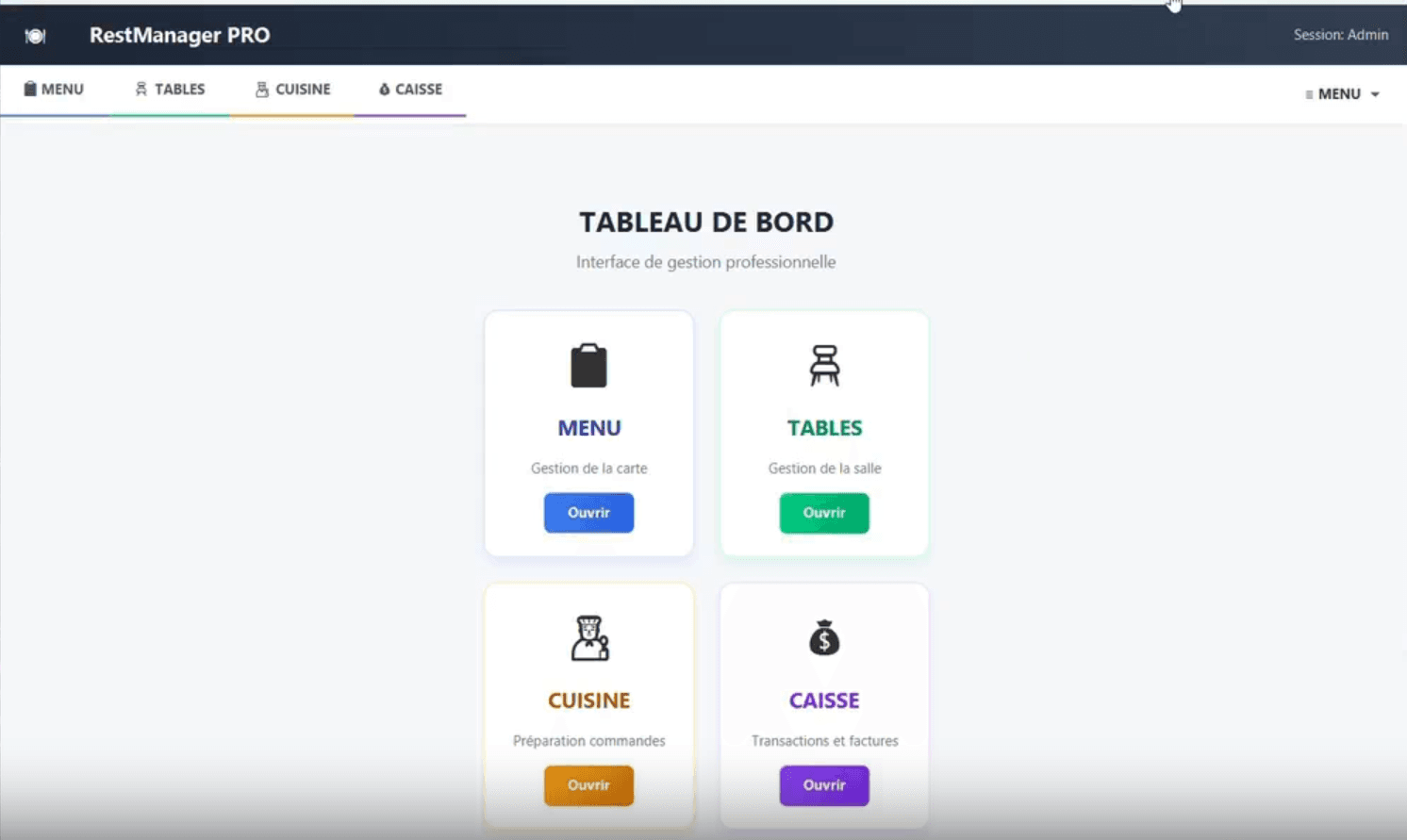
JavaFX desktop interface for menu management, tables, order states, payments, and history views.
Case study
Java desktop application for restaurant operations: menu, tables, orders, kitchen workflow, payments, and sales tracking.
Role
Java desktop development, persistence modeling, business workflow design, and layered architecture.
Context
RestManager focuses on operational restaurant workflows where order status, table activity, payments, and sales tracking must remain consistent.
Restaurant operations need reliable coordination between menus, tables, orders, payment status, kitchen workflow, and daily sales history.
Built a JavaFX desktop application with Hibernate/JPA persistence, MVC structure, DAO and service layers, and business rules for data consistency.
The layered Java architecture separates UI, services, DAO persistence, and business rules to keep the desktop application maintainable.
A structured view of the technical blocks and responsibilities planned in the project.
Frontend
JavaFX desktop interface for menu management, tables, order states, payments, and history views.
Backend
Service layer and DAO structure separating business rules from UI interactions.
Database
MySQL persistence through Hibernate/JPA with restaurant entities and relationships.
Authentication
Authentication is not positioned as the core focus; business workflow consistency is the main concern.
Integrations
Maven project structure, IntelliJ IDEA development environment, phpMyAdmin, and README demo video.
Menu, table, order, payment, and sales workflows modeled as restaurant operations.
MVC, DAO, and service layers separate interface, persistence, and business rules.
Automatic total calculation and order status workflow support operational consistency.
Quality is presented as a progressive engineering approach: targeted tests, readability, static analysis, and documented decisions.
The project highlights data consistency through business rules, automatic total calculation, and clear workflow separation.
These takeaways turn the project into evidence of technical reasoning, not just a feature list.